April 09, 2018
Delay Analysis Principle No. 3:
The critical path is the longest path.
Identifying the critical path is one of the very first things we look for when opening a CPM schedule for the first time. It is certainly the first significant step when performing a schedule delay analysis.
Oracle’s Project Management (P6) scheduling software package allows users to identify activities in the project schedule as critical activities by coloring them “red.” The user may identify the critical path either by total float values or by using the software’s longest path feature. The selection of one of these options merely instructs the scheduling software which activities should be colored red. For example, a user could select total float as the way to identify critical activities, and instruct the software that all activities with total float values of 25 workdays or less be identified as critical and colored red.
However, merely identifying activities with certain total float values as critical does not mean that they are automatically on the project’s critical path. Common features of modern CPM scheduling programs thwart the use of float as a reliable indicator of the critical path. As a result, the path of least float, zero float, or most negative float, may not be the critical path – though is used to be a reliable indicator.
In fact, Oracle’s Primavera Project Management (P6) states that projects using multiple calendars should rely on the “longest path” filter to identify the critical path, because “. . .using float to identify
March 26, 2018
Delay Analysis Principle No. 2:
Not every delay to the critical path will delay the project.
As introduced in the Delay Analysis Principle No. 1 blog posting, “only delays to the project’s critical path will delay the project.” However, the converse is not true – “not every delay to the critical path delays the project.”
For a delay to the critical path to not delay the project, some critical path activities must have positive total float values. The most common reason for a critical path activity to have positive total float value is that it has been assigned a “work calendar” containing a non-work period. The classic example is a temperature-sensitive work item, like the placement of concrete and hot mix asphalt (HMA). These work activities would be assigned to a “work calendar” that shows the winter as a non-work period.
Consider the following graphical depiction of the critical path of a roadway project. Note that the project’s critical path consists of excavation, subgrade, and base course work that is followed by the placement of HMA, the striping of the roadway, and substantial completion.
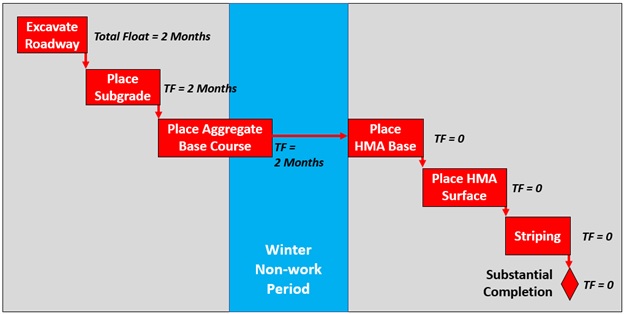
Note that the placement of the aggregate base course is planned to finish during the winter. However, the contractor is unable to place the HMA until the asphalt plants open in the spring. The time between the placement of asphalt aggregate base and the
March 12, 2018
Delays on construction projects are common. Properly identifying the source and magnitude of project delays is the first “essential” step in resolving delay and avoiding disputes. The method used to measure or quantify delays is a function of and dependent upon the type and quality of the project documentation available. Most construction projects use critical path method (CPM) schedules to plan the work and to track progress. Regardless of the scheduling method chosen for the project, there are five basic and immutable principles that should be used to guide every analysis of delays.
Delay Analysis Principle No. 1:
Only delays to the project’s critical path will delay the project.
It is important to recognize that every construction project has a “critical path” – even if it does not have an accompanying CPM schedule. A CPM schedule is merely the time-management tool that enables the project team to more reliably identify the project’s critical path. The critical path is the longest path of activities in the CPM schedule network that calculates the project’s duration.
Based on this fundamental concept, if you were to add one workday to the project’s critical path, then the result would be a one-workday increase to the project’s duration, or said another way, a one-workday delay to the project. Because the critical path is responsible for determining the project’s duration, and an analysis of delay attempts to identify the cause of and measure project delay, every analysis of delays should begin with the identification of the project’s critical path
March 02, 2018
Helping contractors prepare change order requests and claims is one of the things that I do every day. In doing so, I often see them struggle with exactly what they need to include to make their change orders and claims persuasive and, more importantly, successful.
One of the keys to a persuasive and successful change order request or claim is providing adequate documentation.
To fully appreciate what the term “adequate documentation” means, it’s important to consider what I believe are the three main elements of a change order or claim: Entitlement, Impact, and Cost. If we can address each of these, your chances of receiving payment for the change order or claim improves significantly.
Looking at each element in turn, here is the kind of documentation that should be included in a change order request or claim.
Entitlement
What Does the Contract Say?
Referencing your contract and the contractual provisions relevant to the issues are things that I cannot stress enough. By definition, a “change” is something that caused your work to differ from what your contract originally contemplated you would be responsible for. You need to show how the project work, working conditions, or requirements differed from the contract work, conditions, or requirements. Then reference the appropriate contract provision. This becomes the foundation for your change order request or claim.
What are the Facts?
In addition to showing your contract obligations, you also have to establish that the work, conditions, or requirements are, in fact, different from your obligations as set forth in your contract. This
February 12, 2018
The key to resolving delay-related disputes on construction projects is to properly identify the cause of the project delay. Because only delays to the project’s critical path will extend the project’s duration, or delay the project’s completion date, it is essential that construction professionals and construction attorneys be able to define and identify the project’s “critical path.”
The critical path method (CPM) is the standard scheduling method for managing construction projects, and the “critical path” is the defining feature of the CPM scheduling method. One would think that in the past 60 years that CPM scheduling has been used, there would be one, widely-accepted definition for “critical path.” Unfortunately, you’d be wrong. Simply, the critical path is the work path, or sequence of work activities, that forecasts when your “project” will finish.
(As an aside, a critical path exists even if the project didn’t use a CPM schedule. Projects have a critical path whether scheduled with a bar chart, a CPM, or no schedule at all.)
The Oracle Primavera P6 Professional Help website defines the critical path as follows:
The critical path is a series of activities that determines a project’s completion time. The duration of the activities on the critical path controls the duration of the entire project; a delay to any of these activities will delay the finish date of the entire project…
The essential characteristics of this definition of the critical path are that it is a “. . . series of activities that determines a project’s completion. . .” and that
January 29, 2018
Construction is a risky enterprise for contractors. Unplanned and unanticipated events continually occur and should be addressed as quickly as possible. In fact, construction contracts are written specifically to deal with unanticipated events and issues. Properly managing the costs resulting from unanticipated events experienced during construction often determines whether the project is profitable or not.
When unanticipated conditions and issues arise, the contractor’s first action should be to immediately notify the owner of the potential impact (additional costs and time) of the unanticipated event or issue. Contractually, providing proper notice to owners of a potential change or unanticipated event when it arises enables owners to evaluate and address the potential change as quickly and cost effectively as possible. However, more importantly for contractors, properly notifying owners of a potential change or unanticipated event is an essential step in establishing their entitlement to request and recover their additional costs and the corresponding time extension.
Notice requirements are peppered throughout every construction contract and are too often ignored by both parties when unanticipated events are encountered. Do not fall into this trap! Improper notice is referred to as the owner’s “shield” from contractor requests for additional compensation. Contractors must be both knowledgeable of their contractual notice requirements and diligent in fulfilling them to ensure that they put themselves in the best position to recover their additional costs caused by unanticipated events.
For more on this or any other topic, please call me at 215-814-6400 or email me at mark.nagata@traunerconsulting.com.